The MTHFR Gene
What a common gene variant does and doesn’t mean, and what the evidence says about methylation claims
Last reviewed: October 2026 · 38 sources
Educational only, not medical advice. This page shares general information and community experience. It isn’t a diagnosis or a treatment plan. Please talk with your doctor or another licensed healthcare provider before starting, stopping, or changing any test, supplement, medication, or treatment.
At a glance
- What it is: a gene that carries instructions for an enzyme that helps process folate (vitamin B9) and recycle homocysteine [1].
- Very common variants: more people in the U.S. have one or two copies of the C677T variant than don’t [2].
- Not a diagnosis: a variant is a difference in a gene, not a disease. Most gene variants have no effect on health [3].
- Testing: the American College of Medical Genetics and Genomics (ACMG) says MTHFR testing has “minimal clinical utility” and shouldn’t be part of a routine workup for blood clots [4]. A homocysteine blood test is the measure doctors may use when there’s a reason to check [5].
- Folic acid: the CDC says people with MTHFR variants “can process all types of folate, including folic acid,” and should still get folic acid if they could become pregnant [2].
If you’ve had a genetic test, you may have seen “MTHFR” in your results, often with a warning about “methylation” or “detox.” This guide explains what the gene does, what mainstream medicine says about the common variants, and what functional and integrative practitioners believe, with an honest look at the evidence for each. It’s general information, not a diagnosis. A licensed clinician can tell you what, if anything, your results mean for you.
Visual overview
Two original diagrams that summarize ideas covered in the guide below. They are educational only and cannot diagnose a condition or choose treatment.
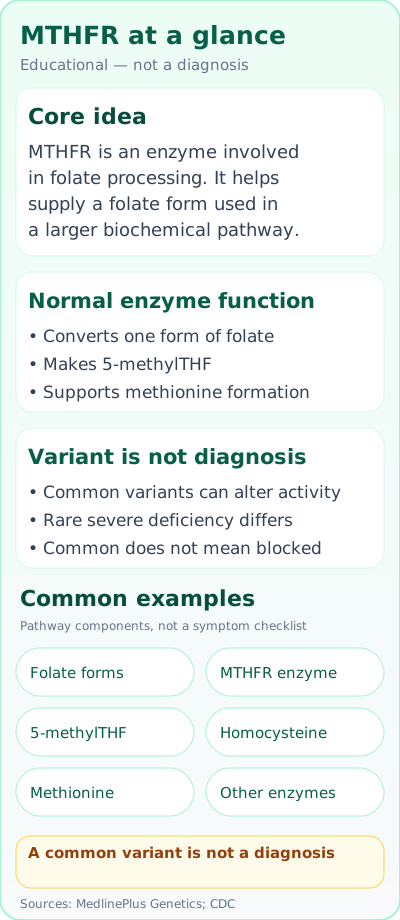
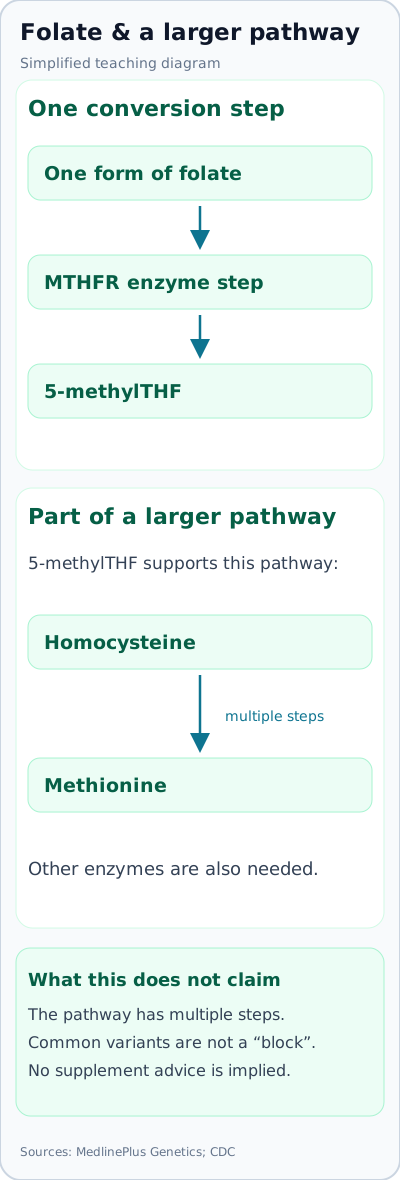
Source notes for these visuals
- MedlinePlus Genetics — MTHFR gene — https://medlineplus.gov/genetics/gene/mthfr/. MTHFR converts 5,10-methylenetetrahydrofolate to 5-methyltetrahydrofolate; supports a multistep process converting homocysteine to methionine. Common variants differ from rare severe deficiency.
- CDC — MTHFR Gene Variant and Folic Acid Facts — https://www.cdc.gov/folic-acid/data-research/mthfr/index.html. People with common MTHFR variants can process folate, including folic acid; a common variant is not proof that folate processing is blocked.
All listed sources opened November 6, 2026. Simplified educational diagrams, not diagnostic images or exact molecular models. Generated device art is illustrative, not a certified product or performance claim; the gut illustration is not a clinical scan. No external image service or tracker was added.
What MTHFR is and what it does
Genes are made of DNA, and many are instructions the body uses to make proteins [6]. Most people have two copies of each gene, one from each parent [6].
The MTHFR gene carries the instructions for an enzyme called methylenetetrahydrofolate reductase [1]. This enzyme converts folate into 5-methyltetrahydrofolate (5-MTHF), the main form of folate in the blood [1]. That active folate is needed to turn the amino acid homocysteine into another amino acid, methionine [1]. Vitamin B12 is part of the same step: the enzyme methionine synthase, which depends on B12, makes that conversion [7].
The body uses methionine to make SAMe (S-adenosylmethionine), which donates “methyl groups” to many molecules [8]. This tagging is called methylation [9]. On DNA, methyl tags help turn genes on or off [9]. One enzyme that uses SAMe is COMT, which helps break down dopamine and some estrogen by-products; see our COMT gene guide.
The common variants and how common they are
A gene variant is a permanent change in a gene’s DNA. It used to be called a “mutation,” but changes in DNA don’t always cause disease [10]. The two best-known MTHFR variants are:
- C677T, the most common MTHFR variant, where the DNA letter “C” is replaced by “T” at position 677 [2].
- A1298C, where “A” is replaced by “C” at position 1298 [2].
These variants are very common. More people in the U.S. have one or two copies of C677T than don’t, and it’s more common in Hispanic people than in non-Hispanic White or Black people [2]. About 25% of Hispanics, 10% of Caucasians and Asians, and 1% of African Americans carry two copies [11].
Both variants make the enzyme work less well, and A1298C has a smaller effect than C677T [12]. Very rare MTHFR variants also exist and can have significant health effects; those are different from the common ones and are a question for a doctor or genetic counselor [2].
A variant is not a condition or a diagnosis
Having an MTHFR variant isn’t an illness. Most gene variants have no effect on health or development [3]. ACMG says that one copy of C677T, two copies of A1298C, or one of each “appear unlikely to be of clinical significance” [4]. It also warns that it’s “not uncommon that medical problems are incorrectly attributed to positive MTHFR status” [4].
What the evidence shows, and doesn’t
Homocysteine
When MTHFR works more slowly, homocysteine can build up, mainly in people with two copies of C677T [1]. Researchers have found that this happens mostly when folate status is low [13]. Folate, vitamin B12 and vitamin B6 all help the body break down homocysteine [5]. A1298C alone hasn’t been linked to higher homocysteine [14].
Heart disease and stroke
High homocysteine was once thought to be a major cause of heart disease. The evidence has weakened:
- A 2002 analysis of 40 studies found that people with two copies of C677T had 16% higher odds of coronary heart disease, with results that differed between regions [15].
- A larger 2005 analysis of 80 studies found “no strong evidence” of a link between C677T and coronary heart disease in Europe, North America or Australia [16].
- A 2017 Cochrane review of randomized trials found that B-vitamin supplements that lower homocysteine didn’t reduce heart attacks or deaths, with a small reduction in stroke [17].
MedlinePlus says routine homocysteine testing to screen for heart disease “isn’t recommended for everyone,” because in most cases lowering homocysteine hasn’t reduced heart attack or stroke risk [5].
Blood clots and pregnancy
MTHFR testing was once common in workups for blood clots and pregnancy loss. ACMG says meta-analyses have “disproven” a link between MTHFR status and the risk of venous blood clots [4]. People with two copies of C677T and normal homocysteine “can be reassured” that there’s no evidence of a higher risk of clots or recurrent pregnancy loss from their MTHFR status [4]. The American College of Obstetricians and Gynecologists (ACOG) says screening with MTHFR testing or fasting homocysteine levels “is not recommended” in pregnancy [18].
Folic acid and neural tube defects
Women with two copies of C677T might have a higher risk of having a baby with a neural tube defect, a birth defect of the brain or spine [11]. Folic acid helps prevent these defects even in people with the variant [2, 11]. The CDC says folic acid is the only type of folate shown to prevent them, and that how much folic acid you get matters more for your blood folate level than your MTHFR genotype [2].
Vitamin B12
B12 and folate work together in the homocysteine-to-methionine step [7]. B12 deficiency is common in some groups, including older adults, people with pernicious anemia or digestive disorders, people who’ve had digestive surgery, and people who follow vegetarian diets [7]. Some experts worry that high folate intake can hide a B12 deficiency until nerve damage becomes permanent [11]. That’s one reason to check B12, not just folate, when there’s a concern.
What mainstream medicine recommends
- Don’t test routinely. ACMG says MTHFR testing “should not be ordered as a part of a routine evaluation for thrombophilia” [4]. The guideline was reaffirmed in 2020 [19].
- Keep taking folic acid if you could become pregnant. The CDC says the idea that people with MTHFR variants should avoid folic acid “is not true” [2].
- Measure what matters. If there’s a reason to check, a homocysteine test can help assess B6, B12 and folate status [5]. It may be ordered if you’re at high risk of low B12 or folate, or have symptoms of a deficiency [5].
- No proven MTHFR-specific treatment. ACMG notes “there is currently no evidence that specific treatments reduce risks associated with hyperhomocysteinemia or MTHFR genotype status” [4].
Functional & integrative perspective · evidence varies
The functional and integrative perspective
Functional and integrative practitioners often pay more attention to MTHFR than mainstream medicine does. These are their views, described in their terms. Read each one as a hypothesis.
How some practitioners see MTHFR
- A routine part of testing. A 2021 review of functional medicine in The Journal of Family Practice lists MTHFR genotyping among common functional medicine tests [20]. The authors note that this approach to homocysteine and MTHFR testing “contrasts with recommendations” from meta-analyses and from guideline groups such as the American Heart Association and the U.S. Preventive Services Task Force [20]. Evidence: mainstream guidelines don’t support routine testing.
- Methylation as a whole-body process. A review co-written by an author at the Institute for Functional Medicine lists folate, vitamin B12 and vitamin B6 among the nutrients that support methylation [21], while urging caution because of “the limitations of current research” [21]. Evidence: methylation is real biochemistry; whether “supporting” it helps people with common variants hasn’t been shown.
Methylfolate, methyl-B12 and folic acid
- The methylfolate argument. Supplements can contain 5-MTHF (“methylfolate”), the active form of folate [11]. The NIH Office of Dietary Supplements says research on people with C677T is “inconclusive,” though “some of these people might benefit” from 5-MTHF [11]. Some practitioners also point to unmetabolized folic acid, which can appear in the blood when intake exceeds what the body converts. Whether it has any biological effect “is not known” [11]. Evidence: mixed and uncertain.
- The mainstream counterpoint. For anyone who could become pregnant, the CDC recommends folic acid, not 5-MTHF, even with an MTHFR variant [2, 11]. Folic acid is the form proven to prevent neural tube defects [2].
- Methyl-B12. A 2017 review by a nutrition consultant and an author who is chief medical officer of a supplement company favored natural forms of B12, such as methylcobalamin, over the synthetic cyanocobalamin [22]. The same review found that all forms are converted to the same active forms inside cells, and that for most people they “may likely have similar bioavailabilities and physiological effects” [22]. Evidence: a narrative review with an industry-linked author; no trials in people with MTHFR variants.
Methylation and “detox”
- The claim. Dr. Neil Nathan lists methylation among the “Phase II” processes, alongside glucuronidation, sulfation and acetylation, that make toxins more water-soluble so the body can remove them [23]. Because of this, an MTHFR result is sometimes presented as a sign of a poor ability to “detox.”
- A skeptic inside the mold world. Dr. Ritchie Shoemaker writes that patients come to him worried that MTHFR and similar gene results mean they can’t properly “detoxify,” and calls “the current overemphasis on SNP measurements alone” a “misunderstanding of basic molecular biology” [24].
- Evidence: methylation is established biochemistry [8]. No study we found shows that a common MTHFR variant slows the body’s clearance of toxins in people [25].
Claimed links to mold, chemical sensitivity and histamine
- Mold. Some mold-illness practitioners discuss MTHFR results. Dr. Nathan advises waiting to treat “methylation compromise” until a person with mold toxicity has improved significantly [26]. Dr. Shoemaker says he sees MTHFR findings in about 80% of his patients and that “there is no need to adjust treatment for this common genetic change” [27]. Evidence: clinical opinion. Our PubMed search found no studies of MTHFR in people with mold illness [25].
- Chemical sensitivity. Researchers have proposed that impaired handling of chemicals could underlie multiple chemical sensitivity (MCS) [28]. A 2004 study that tested several genes, including MTHFR, reported differences in other chemical-processing genes [28]. A 2010 study of about 1,300 people found MTHFR variants “were not associated” with MCS [29]. A 2017 study of 52 patients found a difference in one MTHFR variant compared with controls, but its authors concluded that specific genetic polymorphisms associated with the syndrome “were not identified” [30]. Evidence: three studies with inconsistent results [31]. See our chemical sensitivity guide.
- Histamine and MCAS. The body breaks down histamine mainly with two enzymes, DAO and HNMT [32]. HNMT uses SAMe as its methyl donor [32], which is why some practitioners link methylation to histamine. DAO is the main enzyme for histamine from food [33]. A 2019 narrative review proposed a link between folate, methylation and histamine in mast cell–related bladder pain [34]. Evidence: a hypothesis. Our PubMed search found no studies of MTHFR in mast cell activation [35]. See our MCAS guide.
Food first
Practitioners and mainstream sources agree on one thing: a diet rich in folate. A functional-medicine review lists dietary sources of the nutrients used in methylation [21]. Folate is found in vegetables (especially dark green leafy vegetables), fruits, nuts, beans, peas, seafood, eggs, dairy, meat, poultry and grains [11]. Spinach, liver, asparagus and brussels sprouts are among the richest sources [11]. Vitamin B12 is found in foods of animal origin, and people who follow vegetarian diets are among those at risk of low B12 [7]. Evidence: well-established nutrition guidance.
Where the evidence stands
We searched PubMed in October 2026 and found no studies combining “functional medicine” and MTHFR [36], no studies of MTHFR in mold illness [25], and none in mast cell activation [35]. If you’re working with a practitioner who recommends MTHFR testing or methylation supplements, it’s reasonable to ask what the result will change and what evidence supports the plan. Tell your doctor about every supplement you take.
Want to know who’s behind this site? Read our story.
What to do next
General information, not a diagnosis or a treatment plan. A licensed clinician can tell you which of these steps fit you.
-
Step 1Start with what you have
- If you already have an MTHFR result, remember it’s a common variant, not a diagnosis [3, 4].
- Write down why the test was done and any symptoms you’re concerned about. Our symptom checklist can help.
-
Step 2Choose who to see
- A primary care doctor is a good start.
- If a rare MTHFR variant was found, the CDC suggests talking with your doctor or a genetic counselor [2].
-
Step 3Tests to ask about
-
Step 4Everyday steps mainstream sources support
-
Step 5Prepare for the appointment
- Bring a list of all medicines, vitamins and supplements, including any methylfolate or B12 products. Our doctor visit prep sheet can help.
- Then use the questions below.
-
Step 6When to get urgent care
- Signs of a blood clot, such as sudden chest pain or shortness of breath, need emergency care [37].
- See When to get urgent help.
Questions to ask your doctor
- Does my MTHFR result change anything about my care?
- Would a homocysteine, vitamin B12 or folate blood test be useful for me?
- If my homocysteine is high, what else could be causing it?
- If I could become pregnant, what form of folate do you recommend, and why?
- Is it safe to take methylfolate or methyl-B12 with my other medicines?
- Should I see a genetic counselor, or is that unnecessary for a common variant?
When to get urgent help
Call 911 or go to the emergency room for symptoms of a blood clot in the lungs, such as sudden chest pain that gets worse with deep breathing, sudden shortness of breath, a fast heart rate, or coughing up blood [37]. Get prompt care for a swollen, painful, red or warm leg or arm, which can be a sign of a deep vein clot [38].
Sources
Numbers in brackets in the text link to these sources. Links were checked in October 2026. Some sources are written by people who support a particular approach; we've tried to say so in the text.
- MedlinePlus Genetics (U.S. National Library of Medicine). MTHFR gene. Last updated October 1, 2019. Web page, accessed October 17, 2026. https://medlineplus.gov/genetics/gene/mthfr/
- Centers for Disease Control and Prevention (CDC). MTHFR Gene Variant and Folic Acid Facts. July 16, 2026. Web page, accessed October 17, 2026. https://www.cdc.gov/folic-acid/data-research/mthfr/index.html
- MedlinePlus Genetics (U.S. National Library of Medicine). Do all gene variants affect health and development? Web page, accessed October 17, 2026. https://medlineplus.gov/genetics/understanding/mutationsanddisorders/neutralmutations/
- Hickey SE, Curry CJ, Toriello HV. ACMG Practice Guideline: lack of evidence for MTHFR polymorphism testing. Genet Med. 2013;15(2):153-156. PMID: 23288205. https://doi.org/10.1038/gim.2012.165
- MedlinePlus (U.S. National Library of Medicine). Homocysteine Test. Web page, accessed October 17, 2026. https://medlineplus.gov/lab-tests/homocysteine-test/
- MedlinePlus Genetics (U.S. National Library of Medicine). What is a gene? Web page, accessed October 17, 2026. https://medlineplus.gov/genetics/understanding/basics/gene/
- NIH Office of Dietary Supplements. Vitamin B12: Fact Sheet for Health Professionals. Web page, accessed October 31, 2026. https://ods.od.nih.gov/factsheets/VitaminB12-HealthProfessional/
- Crider KS, Yang TP, Berry RJ, Bailey LB. Folate and DNA methylation: a review of molecular mechanisms and the evidence for folate’s role. Adv Nutr. 2012;3(1):21-38. PMID: 22332098. https://pmc.ncbi.nlm.nih.gov/articles/PMC3262611/
- National Human Genome Research Institute (NHGRI). Talking Glossary of Genomic and Genetic Terms: Methylation. Web page, accessed October 17, 2026. https://www.genome.gov/genetics-glossary/Methylation
- MedlinePlus Genetics (U.S. National Library of Medicine). What is a gene variant and how do variants occur? Web page, accessed October 17, 2026. https://medlineplus.gov/genetics/understanding/mutationsanddisorders/genemutation/
- NIH Office of Dietary Supplements. Folate: Fact Sheet for Health Professionals. Web page, accessed October 17, 2026. https://ods.od.nih.gov/factsheets/Folate-HealthProfessional/
- Royal Dutch Pharmacists Association (KNMP), Dutch Pharmacogenetics Working Group. General background text Pharmacogenetics: Methylenetetrahydrofolate reductase (MTHFR). Last updated December 23, 2020. PDF, accessed October 17, 2026. https://www.knmp.nl/sites/default/files/2023-11/MTHFR_English.pdf
- Bagley PJ, Selhub J. A common mutation in the methylenetetrahydrofolate reductase gene is associated with an accumulation of formylated tetrahydrofolates in red blood cells. Proc Natl Acad Sci U S A. 1998;95(22):13217-13220. PMID: 9789068. https://pmc.ncbi.nlm.nih.gov/articles/PMC23763/
- van der Put NM, Gabreëls F, Stevens EM, et al. A second common mutation in the methylenetetrahydrofolate reductase gene: an additional risk factor for neural-tube defects? Am J Hum Genet. 1998;62(5):1044-1051. PMID: 9545395. https://pmc.ncbi.nlm.nih.gov/articles/PMC1377082/
- Klerk M, Verhoef P, Clarke R, et al. MTHFR 677C-->T polymorphism and risk of coronary heart disease: a meta-analysis. JAMA. 2002;288(16):2023-2031. PMID: 12387655. https://doi.org/10.1001/jama.288.16.2023
- Lewis SJ, Ebrahim S, Davey Smith G. Meta-analysis of MTHFR 677C->T polymorphism and coronary heart disease: does totality of evidence support causal role for homocysteine and preventive potential of folate? BMJ. 2005;331(7524):1053. PMID: 16216822. https://pmc.ncbi.nlm.nih.gov/articles/PMC1283183/
- Martí-Carvajal AJ, Solà I, Lathyris D, Dayer M. Homocysteine-lowering interventions for preventing cardiovascular events. Cochrane Database Syst Rev. 2017;8(8):CD006612. PMID: 28816346. https://pmc.ncbi.nlm.nih.gov/articles/PMC6483699/
- American College of Obstetricians and Gynecologists. ACOG Practice Bulletin No. 197: Inherited Thrombophilias in Pregnancy. Obstet Gynecol. 2018;132(1):e18-e34. PMID: 29939939. Web page, accessed October 17, 2026. https://www.acog.org/clinical/clinical-guidance/practice-bulletin/articles/2018/07/inherited-thrombophilias-in-pregnancy
- Hickey SE, Curry CJ, Toriello HV. Addendum: ACMG Practice Guideline: lack of evidence for MTHFR polymorphism testing. Genet Med. 2020;22(12):2125. https://doi.org/10.1038/s41436-020-0843-0
- Orlando FA, Chang KL, Estores IM. Functional medicine: focusing on imbalances in core metabolic processes. J Fam Pract. 2021;70(10):482-488,498. PMID: 35119987. https://doi.org/10.12788/jfp.0307
- Hodges RE, Minich DM. Modulation of metabolic detoxification pathways using foods and food-derived components: a scientific review with clinical application. J Nutr Metab. 2015;2015:760689. PMID: 26167297. https://pmc.ncbi.nlm.nih.gov/articles/PMC4488002/
- Paul C, Brady DM. Comparative bioavailability and utilization of particular forms of B12 supplements with potential to mitigate B12-related genetic polymorphisms. Integr Med (Encinitas). 2017;16(1):42-49. PMID: 28223907. https://pmc.ncbi.nlm.nih.gov/articles/PMC5312744/
- Nathan N. Newsletter #24: Potentially Ground-Breaking Information for Treating Mold Toxicity. March 31, 2020. Web page, accessed October 17, 2026. https://neilnathanmd.com/potentially-ground-breaking-information-for-treating-mold-toxicity/
- Shoemaker R. Progene DX Pathway to Certainty, Part 2. SurvivingMold.com. Web page, accessed October 17, 2026. https://www.survivingmold.com/progene-dx-pathway-to-certainty-part-2
- PubMed (U.S. National Library of Medicine). Search: MTHFR AND (mold OR mould OR "chronic inflammatory response syndrome" OR biotoxin OR "water-damaged"). Searched October 31, 2026; 22 results, none studying MTHFR in people with mold illness or CIRS (they concern the MTHFR enzyme in yeast, fungi, plants or general biochemistry, plus one newborn case report and one diet study). https://pubmed.ncbi.nlm.nih.gov/?term=MTHFR%20AND%20%28mold%20OR%20mould%20OR%20%22chronic%20inflammatory%20response%20syndrome%22%20OR%20biotoxin%20OR%20%22water-damaged%22%29
- Nathan N. Newsletter #26: 10 Common mistakes in the diagnosis and treatment of mold toxicity. July 6, 2020. Web page, accessed October 17, 2026. https://neilnathanmd.com/newsletter-26-10-common-mistakes-in-the-diagnosis-and-treatment-of-mold-toxicity/
- Shoemaker RC. SurvivingMold.com Frequently Asked Questions, Volume 5 (question 57: MTHFR). SurvivingMold.com; 2010-2013. PDF, accessed October 17, 2026. https://www.survivingmold.com/Downloads/Surviving_Mold_FAQ_Volume_5.pdf
- McKeown-Eyssen G, Baines C, Cole DE, et al. Case-control study of genotypes in multiple chemical sensitivity: CYP2D6, NAT1, NAT2, PON1, PON2 and MTHFR. Int J Epidemiol. 2004;33(5):971-978. PMID: 15256524. https://doi.org/10.1093/ije/dyh251
- Berg ND, Rasmussen HB, Linneberg A, et al. Genetic susceptibility factors for multiple chemical sensitivity revisited. Int J Hyg Environ Health. 2010;213(2):131-139. PMID: 20185366. https://doi.org/10.1016/j.ijheh.2010.02.001
- Loria-Kohen V, Marcos-Pasero H, de la Iglesia R, et al. Multiple chemical sensitivity: genotypic characterization, nutritional status and quality of life in 52 patients. Med Clin (Barc). 2017;149(4):141-146. PMID: 28283271. https://doi.org/10.1016/j.medcli.2017.01.022
- PubMed (U.S. National Library of Medicine). Search: MTHFR AND "multiple chemical sensitivity". Searched October 31, 2026; 3 results (PMIDs 15256524, 20185366, 28283271). https://pubmed.ncbi.nlm.nih.gov/?term=MTHFR%20AND%20%22multiple%20chemical%20sensitivity%22
- Comas-Basté O, Sánchez-Pérez S, Veciana-Nogués MT, Latorre-Moratalla M, Vidal-Carou MC. Histamine intolerance: the current state of the art. Biomolecules. 2020;10(8):1181. PMID: 32824107. https://pmc.ncbi.nlm.nih.gov/articles/PMC7463562/
- Maintz L, Novak N. Histamine and histamine intolerance. Am J Clin Nutr. 2007;85(5):1185-1196. PMID: 17490952. https://doi.org/10.1093/ajcn/85.5.1185
- Keagy CD. The potential role of folate metabolism in interstitial cystitis. Int Urogynecol J. 2019;30(3):363-370. doi:10.1007/s00192-018-3771-7. PMID: 30293165. https://pubmed.ncbi.nlm.nih.gov/30293165/
- PubMed (U.S. National Library of Medicine). Search: MTHFR AND ("mast cell activation" OR mastocytosis OR "mast cell activation syndrome"). Searched October 31, 2026; 0 results. https://pubmed.ncbi.nlm.nih.gov/?term=MTHFR%20AND%20%28%22mast%20cell%20activation%22%20OR%20mastocytosis%20OR%20%22mast%20cell%20activation%20syndrome%22%29
- PubMed (U.S. National Library of Medicine). Search: "functional medicine" AND MTHFR. Searched October 31, 2026; 0 results. https://pubmed.ncbi.nlm.nih.gov/?term=%22functional%20medicine%22%20AND%20MTHFR
- MedlinePlus Medical Encyclopedia. Pulmonary embolus. Web page, accessed October 31, 2026. https://medlineplus.gov/ency/article/000132.htm
- MedlinePlus Medical Encyclopedia. Deep venous thrombosis. Web page, accessed October 31, 2026. https://medlineplus.gov/ency/article/000156.htm