HLA-DR and HLA-DQ Genes
What your immune gene types do and don’t mean, and what the evidence says about “mold-susceptible” HLA claims
Last reviewed: October 2026 · 25 sources
Educational only, not medical advice. This page shares general information and community experience. It isn’t a diagnosis or a treatment plan. Please talk with your doctor or another licensed healthcare provider before starting, stopping, or changing any test, supplement, medication, or treatment.
At a glance
- What they are: HLA-DR and HLA-DQ genes carry instructions for proteins that show fragments of germs and other proteins to the immune system [1].
- Very varied: researchers have identified hundreds of versions of the HLA-DRB1 gene alone [1]. Everyone carries some combination, and most are ordinary.
- Proven links: certain HLA types raise the risk of celiac disease, type 1 diabetes and rheumatoid arthritis, but most people who carry them never develop these conditions [2, 3, 4].
- Testing: HLA typing is mainly used to match organ and bone marrow donors, and in some autoimmune questions [5].
- “Mold-susceptible” types: this idea comes almost entirely from Dr. Ritchie Shoemaker’s own clinic data. Our PubMed search found no independent controlled study confirming it [6, 7].
If you’re exploring CIRS (chronic inflammatory response syndrome) or mold illness, you may have been told about “HLA-DR testing” or that you have a “mold-susceptible” or “multisusceptible” gene type. This guide explains what HLA genes do, where mainstream medicine finds them useful, and what the CIRS framework claims, with an honest look at the evidence for each. It’s a companion to our MTHFR and COMT gene guides. It’s general information, not a diagnosis. A licensed clinician can tell you what, if anything, your results mean for you.
Visual overview
Two original diagrams that summarize ideas covered in the guide below. They are educational only and cannot diagnose a condition or choose treatment.
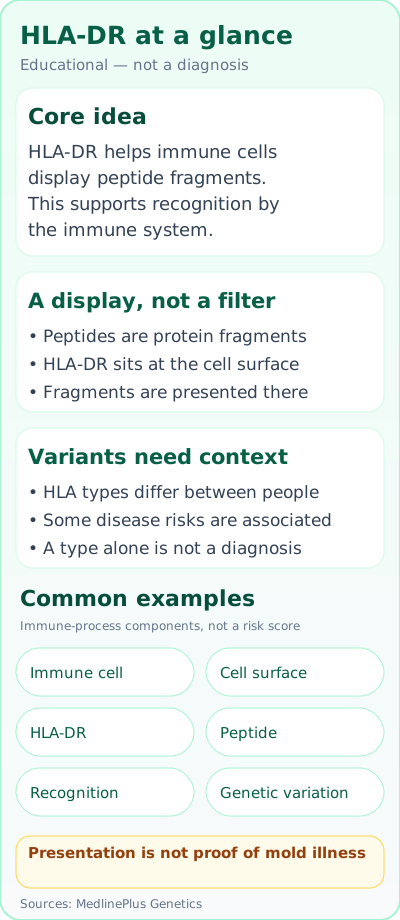
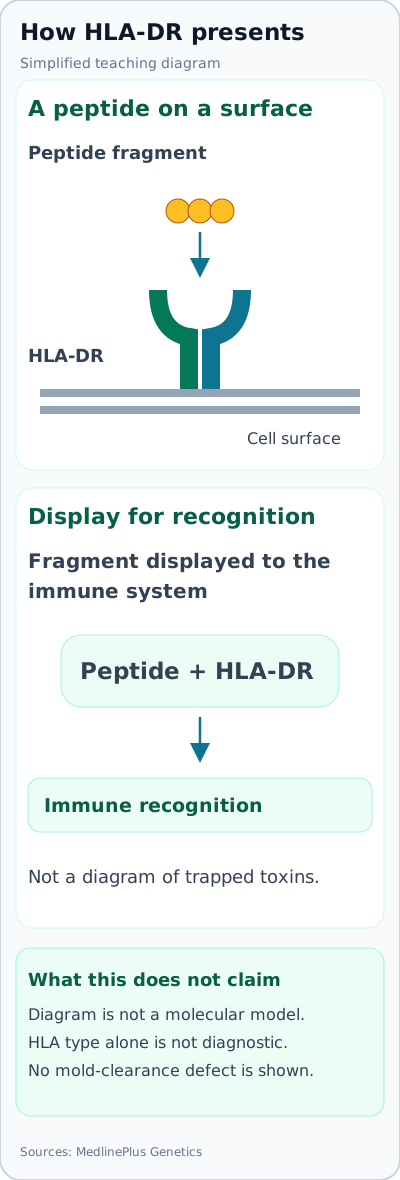
Source notes for these visuals
- MedlinePlus Genetics — HLA-DRB1 gene — https://medlineplus.gov/genetics/gene/hla-drb1/. HLA-DRB1 beta and HLA-DRA alpha chains form HLA-DR, which displays peptide fragments to the immune system. Genetic associations are not diagnoses. This normal function does not itself establish mold clearance or a CIRS-susceptibility mechanism.
All listed sources opened November 6, 2026. Simplified educational diagrams, not diagnostic images or exact molecular models. Generated device art is illustrative, not a certified product or performance claim; the gut illustration is not a clinical scan. Immune recognition does not by itself mean disease. No external image service or tracker was added.
What HLA genes are and what they do
Genes are made of DNA, and most people have two copies of each gene, one from each parent [8]. HLA stands for human leukocyte antigen. HLA genes form a group called the HLA complex, which helps the immune system tell the body’s own proteins apart from proteins made by invaders such as viruses and bacteria [1].
HLA-DR and HLA-DQ belong to “class II” of this complex [3]. The HLA-DRB1 gene makes one half (the beta chain) of the HLA-DR protein, which pairs with an alpha chain made by another gene [1]. This protein binds to protein fragments (peptides) from outside the cell and presents them to the immune system. If the immune system sees the fragments as foreign, it mounts a response [1]. HLA-DQ proteins work the same way: proteins from the HLA-DQA1 and HLA-DQB1 genes join to form one antigen-binding complex [2].
Why HLA types vary so much
HLA genes are among the most varied in the body. Researchers have identified hundreds of versions (alleles) of HLA-DRB1, each with a number such as HLA-DRB1*04:01 [1]. These differences change the part of the protein that grips germ fragments [1], which helps a population respond to many different infections.
A gene variant is a permanent change in a gene’s DNA, and changes in DNA don’t always cause disease [9]. Most variants have no impact on health [10]. Your HLA type is a bit like a blood type: everyone has one, and carrying a particular one is not a condition or a diagnosis.
Well-established HLA disease links
Celiac disease
Almost all people with celiac disease carry specific HLA-DQ variants, known as DQ2 and DQ8 [2]. But these variants are found in about 30 percent of the general population, and only about 3 percent of people who carry them develop celiac disease [2]. That’s why the test is useful mainly to rule celiac disease out: the NIH says that if you don’t have these variants, you are “very unlikely” to have it [11]. Doctors most often use blood tests and small-intestine biopsies to check for celiac disease [11].
Type 1 diabetes
Certain combinations of HLA-DQA1, HLA-DQB1 and HLA-DRB1 variants carry the highest risk of type 1 diabetes, and other HLA types appear protective [3]. HLA variations account for about 40 percent of the genetic risk [3], so many other genes and factors matter too.
Rheumatoid arthritis
Variations in HLA-DRB1 are the most significant known genetic risk factor for rheumatoid arthritis [1, 4]. Many risk versions share a short protein sequence called the “shared epitope,” which makes the HLA protein more likely to bind the body’s own proteins [1]. Many genetic and environmental factors are involved [4].
Other conditions
MedlinePlus lists HLA-DRB1 links with many other conditions, including Graves’ disease, Hashimoto’s disease, narcolepsy and Lyme disease [1]. In each case, the HLA type changes risk; it doesn’t decide who gets ill.
What HLA typing can and can’t tell you
- What it’s used for. HLA typing (also called tissue typing) is a blood test mainly used to match donors for organ and bone marrow transplants. It can also help with some autoimmune questions, because some HLA types are more common in certain autoimmune diseases [5].
- What it can’t do. Because common HLA types are carried by many healthy people, a “risk” type alone doesn’t show that you have, or will get, a disease. The celiac example makes this clear: about 30 percent of people carry DQ2 or DQ8, but only about 3 percent of carriers develop celiac disease [2].
- Consumer tests. Direct-to-consumer gene tests are sold without a healthcare provider. MedlinePlus notes that their results usually need further testing through a provider before they can guide healthcare decisions [12]. The FDA generally doesn’t review tests for “non-medical, general wellness, or low risk medical purposes” before they’re sold, and suggests discussing results with a genetic counselor or qualified health care provider [13].
What guideline bodies say
- Celiac disease. HLA-DQ testing has an accepted, limited role: it helps rule celiac disease out, while blood tests and biopsy are the main tools [11].
- Mold-related illness. We found no mainstream guideline that recommends HLA typing for mold exposure. The American Academy of Allergy, Asthma & Immunology wrote that many mold-related illnesses proposed in recent years “remain largely or completely unproved” [14]. A 2023 German multi-society guideline on indoor mold diagnostics does not mention HLA typing for mold-related illness [15]. A 2019 review argues that the existence of “toxic mold syndrome” has been disproven, while agreeing that molds can cause allergies and trigger asthma [16].
Functional & integrative perspective · evidence varies
The functional and CIRS perspective
CIRS is a practitioner-led framework that mainstream groups don’t accept. The views below are attributed to their sources, and each has an honest evidence label. They aren’t medical advice. See our CIRS guide for the full model.
Shoemaker’s HLA haplotype framework
- The claim. Dr. Ritchie Shoemaker proposes that people with certain HLA-DR/DQ types have trouble recognizing and clearing biotoxins, such as those from water-damaged buildings, so their inflammation keeps going [17, 18]. He writes that about 95% of his cases have one of six HLA haplotypes that “comprise 24% of the normal population” [18]. Evidence: a hypothesis based on his own clinic’s patients.
- The categories. Practitioners write these types as three numbers for the DRB1, DQ and DRB3/4/5 genes (for example, 4-3-53). An integrative physician’s essay hosted by Shoemaker’s organization lists “multi-susceptible” types (4-3-53, 11-3-52B, 12-3-52B, 14-5-52B), “mold specific” types (7-2-53, 7-3-53, 13-6-52A, B or C, 17-2-52A, 18-4-52A), and others for Lyme, ciguatera-type toxins, nasal staph and “low risk” [17]. Evidence: a classification drawn from Shoemaker’s clinical data; not independently validated.
- The data behind it. The main source is a 2009 conference paper by Dr. Shoemaker and a colleague, based on charts reviewed after the fact from 850 patients and 150 controls at his own clinic. It reported six haplotypes more common in patients than controls, with relative risk above 2 [19]. A 2010 study from the same clinic included HLA-DR typing in a case definition for chronic ciguatera [20]. Evidence: single-clinic data, not peer-reviewed in a journal (2009) and not independently replicated.
How practitioners use it
- As one diagnostic clue. The CIRS consensus statement from Shoemaker’s group lists “HLA DR by PCR” among the objective tests used in its diagnostic process [21]. Evidence: a consensus of practitioners who use the framework, not an independent guideline.
- To explain who stays sick. The integrative physician’s essay says that in people with susceptible HLA types, the immune system “cannot see the biotoxins” and “The toxin isn’t recognized as foreign” [17]. Practitioners use this to explain why some people in a damp building stay ill while others recover. Evidence: an untested explanation.
- Not required. Dr. Shoemaker says about 5% of his patients don’t have a susceptible HLA type and still need treatment [18]. So, even in his framework, the test doesn’t rule CIRS in or out. Evidence: his own clinical estimate.
Is there independent support?
We searched PubMed in October 2026 for HLA together with water-damaged buildings, CIRS, biotoxins, sick building syndrome, dampness or mold illness. Of 27 results, only two were relevant to the CIRS claim: a 2010 ciguatera study from Shoemaker’s clinic [20] and a single 2016 case report by other authors describing a patient with a “multisusceptible haplotype” [6, 22]. A search for HLA and mycotoxins in humans found one 2024 report of four cases that described HLA-DR variants in people with lingering mold-related symptoms [23, 24]. A search for Shoemaker-authored papers on HLA returned two, both on ciguatera rather than mold [7]. Evidence: we found no independent, controlled study that tested whether these HLA types are more common in people with mold-related illness.
Critiques
- From the founder. Dr. Shoemaker himself writes that “HLA research is in its infancy” and that a very large multi-site study would be needed [18].
- Common gene types. If six haplotypes cover about a quarter of people [18], many people carry them and stay well. Celiac disease shows the same problem: common risk types predict little on their own [2].
- Mainstream skepticism. Allergy specialists say proposed mold illnesses remain “largely or completely unproved” [14], and the German guideline doesn’t mention HLA typing for mold [15].
Where the evidence stands
The “mold-susceptible” HLA idea rests largely on Dr. Shoemaker’s own clinic data, plus a few case reports. It hasn’t been confirmed by independent controlled studies. If a practitioner recommends HLA typing, it’s reasonable to ask what the result will change about your care. Remediating a water-damaged home is worthwhile whatever your HLA type; see our clean indoor air guide.
Want to know who’s behind this site? Read our story.
What to do next
General information, not a diagnosis or a treatment plan. A licensed clinician can tell you which of these steps fit you.
-
Step 1Start with what you have
- If a report lists your HLA type, remember that everyone has one and most types are ordinary [1].
- Write down why you were tested and any symptoms that concern you. Our symptom checklist can help.
-
Step 2Choose who to see
- A primary care clinician is a good start.
- For celiac, diabetes or joint symptoms, ask whether a specialist referral makes sense.
-
Step 3Tests to ask about
-
Step 4Everyday steps mainstream sources support
- Fix moisture and mold problems at home; see our clean indoor air guide. Evidence: well-supported for allergy and asthma [16].
- Don’t cut out gluten before celiac testing; tell your clinician first [11].
-
Step 5Prepare for the appointment
- Bring your report and a list of all medicines and supplements. Our doctor visit prep sheet can help.
- Then use the questions below.
-
Step 6When to get urgent care
- Someone with diabetes who has fruity breath, trouble breathing or decreased consciousness needs emergency care [25].
- See When to get urgent help.
Questions to ask your doctor
- Does my HLA result change anything about my care?
- Would an HLA test help answer a specific question for me, such as celiac disease?
- If I have a “risk” HLA type, what is my actual chance of developing that condition?
- Could my symptoms have other causes we should check first?
- If I’m exploring CIRS, what evidence supports the tests and treatments being suggested?
- Would a genetic counselor be useful for me?
When to get urgent help
Go to the emergency room or call 911 if a person with diabetes has decreased consciousness, fruity breath, nausea and vomiting, or trouble breathing, which can be signs of diabetic ketoacidosis [25].
Sources
Numbers in brackets in the text link to these sources. Links were checked in October 2026. Some sources are written by people who support a particular approach; we've tried to say so in the text.
- MedlinePlus Genetics (U.S. National Library of Medicine). HLA-DRB1 gene. Web page, accessed October 31, 2026. https://medlineplus.gov/genetics/gene/hla-drb1/
- MedlinePlus Genetics (U.S. National Library of Medicine). Celiac disease. Web page, accessed October 31, 2026. https://medlineplus.gov/genetics/condition/celiac-disease/
- MedlinePlus Genetics (U.S. National Library of Medicine). Type 1 diabetes. Web page, accessed October 31, 2026. https://medlineplus.gov/genetics/condition/type-1-diabetes/
- MedlinePlus Genetics (U.S. National Library of Medicine). Rheumatoid arthritis. Web page, accessed October 31, 2026. https://medlineplus.gov/genetics/condition/rheumatoid-arthritis/
- MedlinePlus Medical Encyclopedia. Histocompatibility antigen test (HLA typing). Web page, accessed October 31, 2026. https://medlineplus.gov/ency/article/003550.htm
- PubMed (U.S. National Library of Medicine). Search: (HLA OR "human leukocyte antigen" OR "HLA-DR") AND ("water-damaged" OR "chronic inflammatory response syndrome" OR CIRS OR biotoxin* OR "sick building" OR "damp indoor" OR "mold illness" OR "mould illness" OR "toxic mold" OR "dampness"). Searched October 31, 2026; 27 results; only two concern the CIRS HLA claim: PMID 20685390 (Shoemaker group, ciguatera) and PMID 27165859 (single case report). https://pubmed.ncbi.nlm.nih.gov/?term=%28HLA%20OR%20%22human%20leukocyte%20antigen%22%20OR%20%22HLA-DR%22%29%20AND%20%28%22water-damaged%22%20OR%20%22chronic%20inflammatory%20response%20syndrome%22%20OR%20CIRS%20OR%20biotoxin%2A%20OR%20%22sick%20building%22%20OR%20%22damp%20indoor%22%20OR%20%22mold%20illness%22%20OR%20%22mould%20illness%22%20OR%20%22toxic%20mold%22%20OR%20%22dampness%22%29
- PubMed (U.S. National Library of Medicine). Search: Shoemaker RC[au] AND (HLA OR "human leukocyte antigen"). Searched October 31, 2026; 2 results (PMIDs 20685390 and 25889530, both on ciguatera). https://pubmed.ncbi.nlm.nih.gov/?term=Shoemaker%20RC%5Bau%5D%20AND%20%28HLA%20OR%20%22human%20leukocyte%20antigen%22%29
- MedlinePlus Genetics (U.S. National Library of Medicine). What is a gene? Web page, accessed October 17, 2026. https://medlineplus.gov/genetics/understanding/basics/gene/
- MedlinePlus Genetics (U.S. National Library of Medicine). What is a gene variant and how do variants occur? Web page, accessed October 17, 2026. https://medlineplus.gov/genetics/understanding/mutationsanddisorders/genemutation/
- MedlinePlus Genetics (U.S. National Library of Medicine). Do all gene variants affect health and development? Web page, accessed October 17, 2026. https://medlineplus.gov/genetics/understanding/mutationsanddisorders/neutralmutations/
- National Institute of Diabetes and Digestive and Kidney Diseases (NIDDK). Diagnosis of Celiac Disease. Web page, accessed October 31, 2026. https://www.niddk.nih.gov/health-information/digestive-diseases/celiac-disease/diagnosis
- MedlinePlus Genetics (U.S. National Library of Medicine). What is direct-to-consumer genetic testing? Web page, accessed October 31, 2026. https://medlineplus.gov/genetics/understanding/dtcgenetictesting/directtoconsumer/
- U.S. Food and Drug Administration. Direct-to-Consumer Tests. Web page, accessed October 31, 2026. https://www.fda.gov/medical-devices/in-vitro-diagnostics/direct-consumer-tests
- Bush RK, Portnoy JM, Saxon A, Terr AI, Wood RA. The medical effects of mold exposure (AAAAI position paper). J Allergy Clin Immunol. 2006;117(2):326-333. PMID: 16514772. https://doi.org/10.1016/j.jaci.2005.12.001
- Hurraß J, Heinzow B, Walser-Reichenbach S, et al. AWMF mold guideline "Medical clinical diagnostics for indoor mold exposure" - Update 2023. Allergol Select. 2024;8:90-198. PMID: 38756207. https://pmc.ncbi.nlm.nih.gov/articles/PMC11097193/
- Chang C, Gershwin ME. The Myth of Mycotoxins and Mold Injury. Clin Rev Allergy Immunol. 2019;57(3):449-455. PMID: 31608429. https://doi.org/10.1007/s12016-019-08767-4
- Hoffman B (integrative physician). Chronic Inflammatory Response Syndrome (CIRS): Evaluation and Treatment. Essay hosted by Surviving Mold. PDF, accessed October 31, 2026. https://www.survivingmold.com/docs/HOFFMANESSAY1.PDF
- Surviving Mold. Bi-weekly member questions, week of February 5, 2024 (Dr. Ritchie Shoemaker). https://www.survivingmold.com/physicians/dashboard/faq/bi-weekly-member-questions/week-of-february-5-2024
- Shoemaker R, Maizel M. Innate immunity, MR spectroscopy, HLA DR, TGF beta-1, VIP and capillary hypoperfusion define acute and chronic human illness acquired following exposure to water-damaged buildings. Healthy Buildings 2009 (conference paper). https://www.survivingmold.com/docs/Resources/Shoemaker%20Papers/213v1.pdf
- Shoemaker RC, House D, Ryan JC. Defining the neurotoxin derived illness chronic ciguatera using markers of chronic systemic inflammatory disturbances: a case/control study. Neurotoxicol Teratol. 2010;32(6):633-639. PMID: 20685390. https://doi.org/10.1016/j.ntt.2010.05.007
- Shoemaker R, Johnson K, Jim L, et al. Diagnostic Process for Chronic Inflammatory Response Syndrome (CIRS): A Consensus Statement. Report of the Consensus Committee of Surviving Mold. Internal Medicine Review. 2018;4(5). https://www.survivingmold.com/Publications/CIRS_diagnostic_protocol_final_5_1_2018.pdf
- Gunn SR, Gunn GG, Mueller FW. Reversal of refractory ulcerative colitis and severe chronic fatigue syndrome symptoms arising from immune disturbance in an HLA-DR/DQ genetically susceptible individual with multiple biotoxin exposures. Am J Case Rep. 2016;17:320-325. PMID: 27165859. https://pmc.ncbi.nlm.nih.gov/articles/PMC4913732/
- Saghir SA, Ansari RA. HLA gene variations and mycotoxin toxicity: four case reports. Mycotoxin Res. 2024;40(1):159-173. PMID: 38198040. https://doi.org/10.1007/s12550-023-00517-y
- PubMed (U.S. National Library of Medicine). Search: (HLA OR "human leukocyte antigen") AND (mycotoxin* OR ochratoxin OR trichothecene OR aflatoxin) AND humans[mh]. Searched October 31, 2026; 27 results; one human report on HLA-DR and mold-related symptoms (PMID 38198040, four cases); the rest are lab, cancer or unrelated studies. https://pubmed.ncbi.nlm.nih.gov/?term=%28HLA%20OR%20%22human%20leukocyte%20antigen%22%29%20AND%20%28mycotoxin%2A%20OR%20ochratoxin%20OR%20trichothecene%20OR%20aflatoxin%29%20AND%20humans%5Bmh%5D
- MedlinePlus Medical Encyclopedia. Diabetic ketoacidosis. Web page, accessed October 31, 2026. https://medlineplus.gov/ency/article/000320.htm