The COMT Gene
What the common “slow COMT” variant does and doesn’t mean, and what the evidence says about functional medicine claims
Last reviewed: October 2026 · 28 sources
Educational only, not medical advice. This page shares general information and community experience. It isn’t a diagnosis or a treatment plan. Please talk with your doctor or another licensed healthcare provider before starting, stopping, or changing any test, supplement, medication, or treatment.
At a glance
- What it is: a gene that carries instructions for an enzyme called catechol-O-methyltransferase, which helps break down brain chemicals such as dopamine and helps control the levels of certain hormones [1].
- The variant behind “slow COMT”: Val158Met (rs4680) swaps one building block in the enzyme, and the “Met” version is less active [1, 2, 3].
- Not a diagnosis: it’s a common variant. Most single-letter DNA differences have no effect on health [4].
- Mixed research: large reviews of mental health conditions, breast cancer and pain have found inconsistent or subgroup-only links [5, 6, 7].
- No clinical guidance acts on it: the pharmacogenetics group CPIC has found the evidence too weak for prescribing recommendations [8, 9].
If you’ve had a consumer gene test, you may have seen “COMT” or “slow COMT” in your results, sometimes with advice about stress, estrogen or “methylation.” This guide is a companion to our MTHFR gene guide. It explains what COMT does, what mainstream research says about its common variant, and what functional and integrative practitioners believe, with an honest look at the evidence for each. It’s general information, not a diagnosis. A licensed clinician can tell you what, if anything, your results mean for you.
Visual overview
Two original diagrams that summarize ideas covered in the guide below. They are educational only and cannot diagnose a condition or choose treatment.
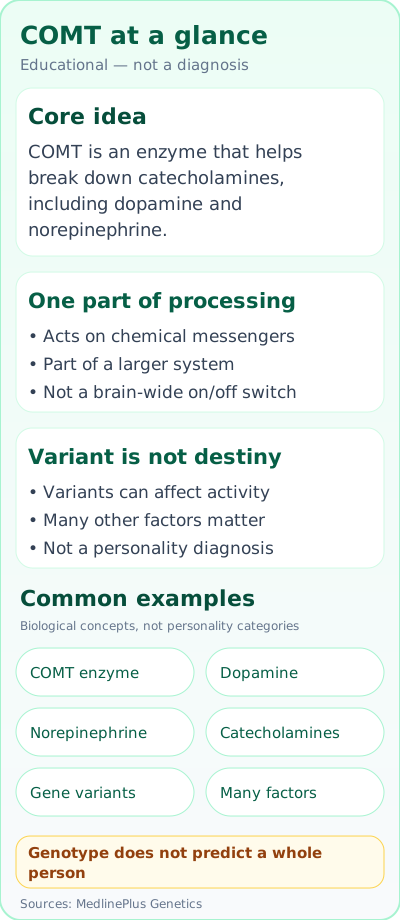
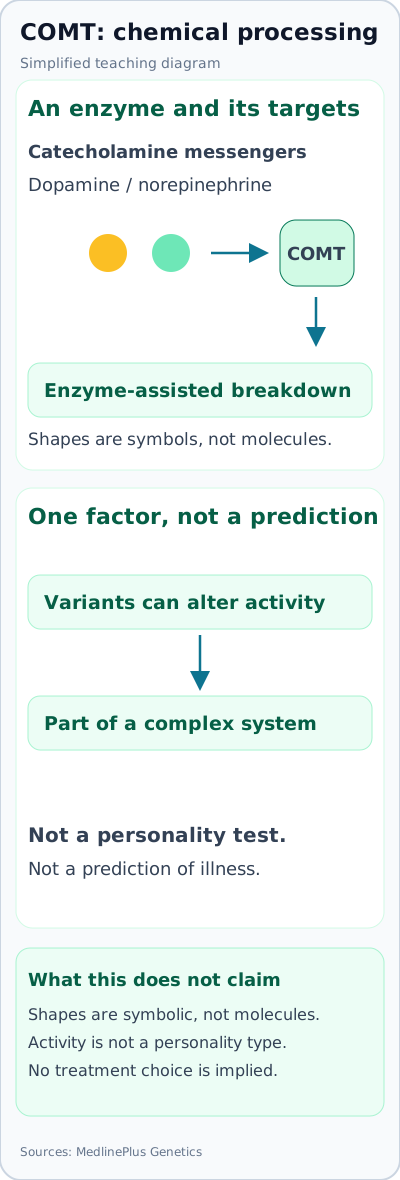
Source notes for these visuals
- MedlinePlus Genetics — COMT gene — https://medlineplus.gov/genetics/gene/comt/. COMT helps break down catecholamine neurotransmitters, including dopamine and norepinephrine. The Val158Met variant can affect activity; complex condition associations involve many factors and are not deterministic.
All listed sources opened November 6, 2026. Simplified educational diagrams, not diagnostic images or exact molecular models. Generated device art is illustrative, not a certified product or performance claim; the gut illustration is not a clinical scan. No external image service or tracker was added.
What COMT is and what it does
Genes are made of DNA, and many are instructions the body uses to make proteins [10]. Most people have two copies of each gene, one from each parent [10].
The COMT gene provides instructions for making an enzyme called catechol-O-methyltransferase [1]. The body makes two forms. A longer form is mainly made by nerve cells in the brain. A shorter form is made in the liver, kidneys and blood, and helps control the levels of certain hormones [1].
In the brain, COMT matters most in the prefrontal cortex, the area at the front of the brain that organizes and coordinates information [1]. That area relies on chemical messengers such as dopamine and norepinephrine, and COMT helps keep their levels in balance [1].
COMT does its job by attaching a small “methyl group” to its targets. It takes that methyl group from SAMe (S-adenosylmethionine) and needs magnesium to work [11]. Besides dopamine, norepinephrine and adrenaline, its targets include “catechol estrogens,” which are breakdown products of estrogen [11]. SAMe is made in the same methylation cycle that involves folate and the MTHFR enzyme; see what MTHFR does.
The Val158Met variant, or “slow COMT”
A gene variant is a permanent change in a gene’s DNA. Changes in DNA don’t always cause disease [12]. The most studied COMT variant is a single-letter change called Val158Met, also written rs4680 or Val108/158Met [1, 3]. It replaces the amino acid valine (“Val”) with methionine (“Met”) [1, 2].
- What it changes: the variant affects the stability and activity of the enzyme [1]. A 1996 study linked it to a “three-to-four-fold variation” in COMT activity [2].
- In the brain: a 2004 study of postmortem human brain tissue found the variant “significantly affected protein abundance and enzyme activity,” and that Val is a main factor behind higher COMT activity in the prefrontal cortex [3]. The same study found that sex and another nearby variant had small effects too [3].
- Where “slow” comes from: people with two Met copies make the less active, “slower” enzyme, and people with two Val copies make the more active, “faster” one [3, 13]. Having one of each falls in between.
This kind of single-letter difference, called a SNP, is the most common type of genetic variation among people [4].
A variant is not a condition
Carrying a “slow” or “fast” COMT variant isn’t a disease, and it doesn’t tell you that you have, or will get, any condition. Most SNPs have no effect on health or development [4], and most gene variants have no impact on health [14]. Enzyme activity also depends on more than one variant, and on factors such as sex [3].
There is one rare situation where COMT clearly matters. In 22q11.2 deletion syndrome, a piece of chromosome 22 is missing, so people have only one copy of the COMT gene instead of two [1]. People with this syndrome are much more likely to develop schizophrenia, depression, anxiety and bipolar disorder, and researchers think COMT changes may help explain part of that risk [1]. It is identified through clinical genetic testing, not inferred from a consumer SNP report.
What the research shows, and doesn’t
Mental health
Researchers have looked extensively at whether Val158Met affects the risk of schizophrenia. Those studies “have had mixed results,” and most studies report no evidence of higher risk with either version [1]. It has also been studied in bipolar disorder, panic disorder, anxiety, OCD, eating disorders and ADHD, but “many factors play a part” in these complex conditions [1].
A 2018 meta-analysis of 363 datasets covering 15 psychiatric conditions found only scattered links within certain subgroups, defined by ethnicity, sex or age of onset, and none that applied across a whole condition [5]. Evidence: large but inconsistent; no use for predicting an individual’s risk.
Thinking and working memory
The variant is often linked to working memory and attention [1]. But a 2015 meta-analysis of brain-scan studies reported a “lack of meta-analytic evidence” that Val158Met changes brain activity during working memory tasks [15].
Pain and fibromyalgia
A 2025 meta-analysis of 16 studies found the Met version more common in people with fibromyalgia overall, but no link when the studies were split by region (Europe, Latin America or Asia) [7]. Among people who already had fibromyalgia, those with two Met copies reported higher symptom-impact scores [7]. Evidence: mixed; not a test for fibromyalgia.
Estrogen and breast cancer
COMT is one of the important enzymes in estrogen metabolism [6], which is why its variants have been studied in breast cancer. A 2012 meta-analysis of 56 studies with more than 34,000 cases found no significant link, and concluded the variant “may not contribute to breast cancer susceptibility” [6]. Another 2012 meta-analysis found “no evidence of significant association” overall [16]. Evidence: large studies show no clear link.
The limits of consumer gene tests
Direct-to-consumer gene tests are sold without a healthcare provider, and they may report traits, wellness factors, medication responses and disease risks [17]. MedlinePlus notes that additional testing through a healthcare provider is usually required before these results can be used to make healthcare decisions, and that few regulations apply to these tests [17].
The FDA says it generally does not review direct-to-consumer tests for “non-medical, general wellness, or low risk medical purposes” before they’re sold [18]. It advises consumers to consider discussing results with a genetic counselor or qualified health care provider [18]. A “slow COMT” label on a wellness report is usually in this category: it describes a common SNP, not a validated medical finding.
What clinical guidance bodies say
- CPIC (Clinical Pharmacogenetics Implementation Consortium). COMT has been reviewed for opioids and some other medicines. Every COMT pairing is rated level C or C/D, and CPIC says pairs at these levels are “not considered to have adequate evidence or actionability to have prescribing recommendations” [8, 19]. Its 2021 opioid guideline describes “the limited and/or weak data” for COMT [9].
- ClinGen (NIH-funded Clinical Genome Resource). ClinGen’s COMT page lists only these pharmacogenomic ratings. It adds that people “should not change their health behavior solely on the basis of information contained on this website” [20].
- No routine testing. We found no guideline that recommends COMT testing for mood, stress, hormones or general health. Genetic professionals reserve clinical testing for specific questions, and a licensed clinician or genetic counselor can tell you whether any test fits your situation.
Functional & integrative perspective · evidence varies
The functional and integrative perspective
Functional medicine is a practitioner-led approach. The views below are attributed to their sources, and each has an honest evidence label. They aren’t medical advice.
How some practitioners see “slow COMT”
- A stress and “overflow” gene. A naturopathic clinic page describes COMT variants as limiting the body’s ability to clear catechols “by 3-4 times,” and says those with two Met copies tend to have “lower stress resiliency” [21]. Evidence: the activity difference comes from lab research [2]; claims about personality and stress in a given person aren’t established.
- “Warriors versus worriers.” A 2006 hypothesis paper proposed that Val carriers may handle stress and threats better (“warrior strategy”), while Met carriers may do better on memory and attention tasks (“worrier strategy”) [13]. Practitioners often borrow this framing. Evidence: a hypothesis built on group averages; brain-scan meta-analysis hasn’t confirmed key effects [15].
The methylation link
COMT uses SAMe as its methyl donor [11], so practitioners treat it as a “methylation gene” and often discuss it alongside MTHFR. A review co-written by an author at the Institute for Functional Medicine lists methionine, vitamin B12, vitamin B6, betaine, folate and magnesium as nutrient cofactors for methylation [22]. A naturopathic clinic says “it’s essential” to get B vitamins and magnesium to support COMT [21]. Evidence: the biochemistry is real; no trials show that “supporting” methylation changes health outcomes in people with a COMT variant.
One case report described improvement in a person with hyperadrenergic POTS and one copy of Val158Met after methylated B vitamins [23]. Evidence: a single case report; not tested in trials. See our POTS guide.
The estrogen framing
The same functional-medicine review says COMT “has received wide attention” for its role in estrogen “detoxification” [22]. COMT does process catechol estrogens [11]. A naturopathic clinic goes further, saying excess estrogen slows COMT and that this can have “a cascading effect” [21]. Evidence: the enzyme chemistry is established, but large meta-analyses found no clear link between the variant and breast cancer [6, 16], and we found no studies showing that genotype-based estrogen plans help.
The catecholamine framing
Because COMT breaks down dopamine and norepinephrine [1], practitioners connect “slow COMT” with anxiety, feeling wired, or a slow return to calm after stress. A naturopathic clinic suggests limiting caffeine, which “can trigger the release of catechols” [21]. Evidence: plausible biology; not studied as a COMT-specific approach. Reducing caffeine is low-risk for most people, but talk with your clinician if you have a health condition.
Diet and lifestyle approaches
- Foods for methylation nutrients. The functional-medicine review lists foods that supply these nutrients, such as meat, fish, eggs, beans, leafy greens, seeds and whole grains [22]. Evidence: well-established nutrition; not tested for COMT.
- Sugar. The same review says “a high sucrose diet may inhibit methylation enzymes such as COMT” [22]. Evidence: based on limited research cited in a narrative review.
- Caution with “methyl” products. Some practitioners say methyl-donor supplements can make people with “slow COMT” feel worse. We didn’t find trials on this either way. Evidence: practitioner reports only. Tell your clinician about every supplement you take, because some interact with medicines.
A skeptic inside the mold world
Dr. Ritchie Shoemaker writes that patients come to him worried about their “MTHFR, COMT or CBT status” and their ability to “detoxify,” and calls “the current overemphasis on SNP measurements alone” a misunderstanding of basic molecular biology [24]. Evidence: expert opinion from a mold-illness clinician. See our CIRS guide for context.
Where the evidence stands
We searched PubMed in October 2026. “COMT” combined with “functional medicine” returned one unrelated paper [25]. A search for COMT with mold, mycotoxins, chemical sensitivity or mast cells returned 35 papers, mostly plant and fungal biology plus a few lab studies of one mycotoxin, zearalenone, interacting with COMT. None studied people with mold illness, chemical sensitivity or mast cell conditions [26]. We found no randomized trials of diet or supplement plans guided by COMT genotype [27]. If a practitioner recommends a plan based on your COMT result, it’s reasonable to ask what evidence supports it and what it will change.
Want to know who’s behind this site? Read our story.
What to do next
General information, not a diagnosis or a treatment plan. A licensed clinician can tell you which of these steps fit you.
-
Step 1Start with what you have
- If a report says “slow COMT,” remember it’s a common variant, not a diagnosis [4].
- Write down why you tested and any symptoms that concern you. Our symptom checklist can help.
-
Step 2Choose who to see
- A primary care clinician is a good start for symptoms such as anxiety, low mood, pain or hormone concerns.
- For questions about a genetic result, ask about a genetic counselor [18].
-
Step 3Ask before acting on a report
-
Step 4Everyday steps mainstream sources support
- Eat a varied diet with leafy greens, beans and other nutrient-rich foods, as covered in our MTHFR guide. Evidence: nutrition guidance.
- Mention caffeine, alcohol and sleep habits to your clinician if stress or anxiety is a concern.
-
Step 5Prepare for the appointment
- Bring your report and a list of all medicines, vitamins and supplements. Our doctor visit prep sheet can help.
- Then use the questions below.
-
Step 6When to get urgent help
- If you’re having thoughts of suicide or a mental health crisis, call or text 988 [28].
- See When to get urgent help.
Questions to ask your doctor
- Does my COMT result change anything about my care?
- Could my symptoms have other causes we should check first?
- Does my COMT result matter for any medicine I take or may take?
- Is it safe to take the supplements I’m using with my other medicines?
- Would a genetic counselor be useful for me, or is that unnecessary for a common variant?
- What would you suggest for managing stress, sleep or anxiety?
When to get urgent help
If you’re in crisis or having thoughts of suicide, call or text the 988 Suicide & Crisis Lifeline [28]. Call 911 for any life-threatening emergency.
Sources
Numbers in brackets in the text link to these sources. Links were checked in October 2026. Some sources are written by people who support a particular approach; we've tried to say so in the text.
- MedlinePlus Genetics (U.S. National Library of Medicine). COMT gene. Web page, accessed October 31, 2026. https://medlineplus.gov/genetics/gene/comt/
- Lachman HM, Papolos DF, Saito T, et al. Human catechol-O-methyltransferase pharmacogenetics: description of a functional polymorphism and its potential application to neuropsychiatric disorders. Pharmacogenetics. 1996;6(3):243-250. PMID: 8807664. https://doi.org/10.1097/00008571-199606000-00007
- Chen J, Lipska BK, Halim N, et al. Functional analysis of genetic variation in catechol-O-methyltransferase (COMT): effects on mRNA, protein, and enzyme activity in postmortem human brain. Am J Hum Genet. 2004;75(5):807-821. PMID: 15457404. https://pmc.ncbi.nlm.nih.gov/articles/PMC1182110/
- MedlinePlus Genetics (U.S. National Library of Medicine). What are single nucleotide polymorphisms (SNPs)? Web page, accessed October 17, 2026. https://medlineplus.gov/genetics/understanding/genomicresearch/snp/
- Taylor S. Association between COMT Val158Met and psychiatric disorders: a comprehensive meta-analysis. Am J Med Genet B Neuropsychiatr Genet. 2018;177(2):199-210. PMID: 28608575. https://doi.org/10.1002/ajmg.b.32556
- Qin X, Peng Q, Qin A, et al. Association of COMT Val158Met polymorphism and breast cancer risk: an updated meta-analysis. Diagn Pathol. 2012;7:136. PMID: 23039364. https://pmc.ncbi.nlm.nih.gov/articles/PMC3543196/
- Lee YH, Song GG. Association of catechol-O-methyltransferase Val158Met polymorphism with fibromyalgia risk and FIQ scores: an updated meta-analysis. Clin Exp Rheumatol. 2025;43(6):1002-1009. PMID: 40153322. https://doi.org/10.55563/clinexprheumatol/8njnoh
- Clinical Pharmacogenetics Implementation Consortium (CPIC). CPIC prioritization: assignment of CPIC levels for genes/drugs. Web page, accessed October 31, 2026. https://cpicpgx.org/prioritization/
- Crews KR, Monte AA, Huddart R, et al. Clinical Pharmacogenetics Implementation Consortium guideline for CYP2D6, OPRM1, and COMT genotypes and select opioid therapy. Clin Pharmacol Ther. 2021;110(4):888-896. PMID: 33387367. https://pmc.ncbi.nlm.nih.gov/articles/PMC8249478/
- MedlinePlus Genetics (U.S. National Library of Medicine). What is a gene? Web page, accessed October 17, 2026. https://medlineplus.gov/genetics/understanding/basics/gene/
- Hall KT, Loscalzo J, Kaptchuk TJ. Systems pharmacogenomics - gene, disease, drug and placebo interactions: a case study in COMT. Pharmacogenomics. 2019;20(7):529-551. PMID: 31124409. https://pmc.ncbi.nlm.nih.gov/articles/PMC6563236/
- MedlinePlus Genetics (U.S. National Library of Medicine). What is a gene variant and how do variants occur? Web page, accessed October 17, 2026. https://medlineplus.gov/genetics/understanding/mutationsanddisorders/genemutation/
- Stein DJ, Newman TK, Savitz J, Ramesar R. Warriors versus worriers: the role of COMT gene variants. CNS Spectr. 2006;11(10):745-748. PMID: 17008817. https://doi.org/10.1017/s1092852900014863
- MedlinePlus Genetics (U.S. National Library of Medicine). Do all gene variants affect health and development? Web page, accessed October 17, 2026. https://medlineplus.gov/genetics/understanding/mutationsanddisorders/neutralmutations/
- Nickl-Jockschat T, Janouschek H, Eickhoff SB, Eickhoff CR. Lack of meta-analytic evidence for an impact of COMT Val158Met genotype on brain activation during working memory tasks. Biol Psychiatry. 2015;78(11):e43-e46. PMID: 25861704. https://doi.org/10.1016/j.biopsych.2015.02.030
- He XF, Wei W, Li SX, et al. Association between the COMT Val158Met polymorphism and breast cancer risk: a meta-analysis of 30,199 cases and 38,922 controls. Mol Biol Rep. 2012;39(6):6811-6823. PMID: 22297695. https://doi.org/10.1007/s11033-012-1506-2
- MedlinePlus Genetics (U.S. National Library of Medicine). What is direct-to-consumer genetic testing? Web page, accessed October 31, 2026. https://medlineplus.gov/genetics/understanding/dtcgenetictesting/directtoconsumer/
- U.S. Food and Drug Administration. Direct-to-Consumer Tests. Web page, accessed October 31, 2026. https://www.fda.gov/medical-devices/in-vitro-diagnostics/direct-consumer-tests
- Clinical Pharmacogenetics Implementation Consortium (CPIC). Gene-drug pairs for COMT (CPIC database). Accessed October 31, 2026. https://cpicpgx.org/genes-drugs/
- ClinGen (Clinical Genome Resource). COMT gene page. Web page, accessed October 31, 2026. https://search.clinicalgenome.org/kb/genes/HGNC:2228
- Harris B (naturopathic physician). COMT Testing. Elan Integrative Health. Web page, accessed October 31, 2026. https://drbreckinharris.com/expertise/methylation-disorders/comt-testing/
- Hodges RE, Minich DM. Modulation of metabolic detoxification pathways using foods and food-derived components: a scientific review with clinical application. J Nutr Metab. 2015;2015:760689. PMID: 26167297. https://pmc.ncbi.nlm.nih.gov/articles/PMC4488002/
- Mittal N, Portera A, Taub P. Improvement of hyperadrenergic postural orthostatic tachycardia syndrome (POTS) with methylated B vitamins in the setting of a heterozygous COMT Val158Met polymorphism. BMJ Case Rep. 2021;14(11):e245012. PMID: 34764114. https://pmc.ncbi.nlm.nih.gov/articles/PMC8586883/
- Shoemaker R. Progene DX Pathway to Certainty, Part 2. SurvivingMold.com. Web page, accessed October 17, 2026. https://www.survivingmold.com/progene-dx-pathway-to-certainty-part-2
- PubMed (U.S. National Library of Medicine). Search: "COMT" AND "functional medicine". Searched October 31, 2026; 1 results (PMID 17405690, a 2007 paper on heavy metals that does not study COMT variants). https://pubmed.ncbi.nlm.nih.gov/?term=%22COMT%22%20AND%20%22functional%20medicine%22
- PubMed (U.S. National Library of Medicine). Search: COMT AND (mold OR mycotoxin OR "multiple chemical sensitivity" OR "mast cell"). Searched October 31, 2026; 35 results, none studying people with mold illness, chemical sensitivity or mast cell conditions (mostly plant and fungal biology, plus lab studies of the mycotoxin zearalenone and COMT). https://pubmed.ncbi.nlm.nih.gov/?term=COMT%20AND%20%28mold%20OR%20mycotoxin%20OR%20%22multiple%20chemical%20sensitivity%22%20OR%20%22mast%20cell%22%29
- PubMed (U.S. National Library of Medicine). Search: COMT AND (diet* OR supplement* OR nutrient*) AND (genotype-guided OR genotype-based OR "personalized nutrition") AND randomized controlled trial[pt]. Searched October 31, 2026; 0 results. https://pubmed.ncbi.nlm.nih.gov/?term=COMT%20AND%20%28diet%2A%20OR%20supplement%2A%20OR%20nutrient%2A%29%20AND%20%28genotype-guided%20OR%20genotype-based%20OR%20%22personalized%20nutrition%22%29%20AND%20randomized%20controlled%20trial%5Bpt%5D
- National Institute of Mental Health (NIMH). Help for Mental Illnesses. Web page, accessed October 10, 2026. https://www.nimh.nih.gov/health/find-help